Ecommerce is no longer just about displaying products online. Modern shoppers want to understand, explore, compare, and experience a product before they buy.
Traditional product listings usually depend on photos, specifications, prices, and descriptions. That approach still works, but it does not always answer the questions customers have before purchasing.
Today, shoppers want to see how a product looks, how it works, and how it fits into their lives.
This shift is creating a new ecommerce strategy: moving from product listings to product experiences.
What Is a Product Listing?
A traditional product listing usually includes:
- Product images
- Product name
- Price
- Product description
- Specifications
- Reviews
- Purchase button
These elements are essential. However, they mainly tell customers about the product.
They do not always show customers what it feels like to use the product.
For example, a fashion store can show several product photos. Yet shoppers may still wonder:
- How does the fabric move?
- How does the outfit look from different angles?
- How will it look when worn?
- Does the fit look realistic?
Similarly, a furniture store can display a sofa with detailed specifications. Customers may still struggle to imagine how it will look inside their own home.
That is where product experiences become more valuable.
What Is a Product Experience?
A product experience goes beyond simply displaying product information.
It helps customers visualize the product, understand its benefits, and imagine using it.
Product experiences can include:
- Product demonstration videos
- AI-generated product videos
- Talking avatar videos
- Virtual try-ons
- Product showcase videos
- Interactive product visuals
- UGC-style content
- Product comparison experiences
- Personalized recommendations
- Short-form product ads
The goal is simple:
Don’t just show the product. Help customers experience it before buying.
Why Product Listings Are No Longer Enough
The ecommerce market has become extremely competitive.
Customers can find similar products from dozens or even hundreds of brands. This makes product differentiation increasingly difficult.
A basic product listing may communicate what a product is.
But a strong product experience communicates:
What it does. Why it matters. How it looks. How it works. And why the customer should care.
That difference can influence purchasing decisions.
When customers only see a product photo, they must create a mental picture themselves.
When they watch a product demonstration, they can see the product in action.
This reduces the amount of imagination required from the shopper.
Video Is Becoming the Core of Product Experiences
Video is one of the strongest formats for demonstrating products.
A single video can communicate information that would otherwise require several images and paragraphs of text.
For example, a 15-second product video can show:
- The product from multiple angles.
- Its key features.
- How it works.
- Its appearance and scale.
- A real-world use case.
- The main customer benefit.
This makes video especially valuable for products that require explanation.
ShowcaseAI helps ecommerce brands create AI-powered product videos from product visuals. These can include product showcases, product avatar videos, talking avatar videos, AI ad videos, and virtual try-on experiences.
The bigger strategic point is that one product can become multiple experiences instead of remaining a single static listing.
Product Pages Are Becoming Digital Showrooms

Think about a physical retail store.
A good store does not simply place products on shelves.
It creates an environment where customers can:
- See products clearly
- Examine them
- Understand their features
- Compare alternatives
- Ask questions
- Imagine using them
Ecommerce is moving toward the same principle digitally.
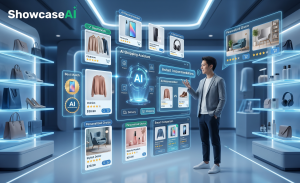
A modern product page can act like a digital showroom.
Instead of showing only product photos, brands can combine:
Images + Video + Demonstration + Reviews + Product Information + Social Proof
This creates a richer buying environment.
The product page becomes less like a catalog and more like an interactive sales experience.
AI Is Making Product Experiences Easier to Create
Creating product experiences traditionally required significant resources.
Brands often needed:
- Photographers
- Models
- Video shoots
- Locations
- Editors
- Scriptwriters
- Designers
- Production teams
That makes frequent content creation expensive.
AI is changing this process.
Brands can now use product images and information as starting points for creating different types of marketing content.
This means businesses can produce product videos without organizing a complete production shoot for every product.
For large ecommerce catalogs, this can significantly change the content workflow.
One Product Can Support Multiple Experiences

A major advantage of AI-powered content is reuse.
Imagine an ecommerce brand launches a new product.
Instead of creating only one product listing, the same product can become:
- A product showcase video
- An Instagram Reel
- A short advertising creative
- A product demonstration
- A talking avatar explanation
- A product-focused social media video
- A virtual try-on experience
- A landing-page video
The product remains the same.
The experience changes according to the customer’s context.
This is important because customers discover products across different channels.
A platform such as ShowcaseAI can help brands transform product assets into different video experiences for product pages, social media, and advertising campaigns.
The Customer Journey Is Becoming More Visual
Ecommerce discovery no longer happens only on product pages.
Customers discover products through:
- Search engines
- AI search
- Social media
- Short-form videos
- Influencer content
- Marketplaces
- Shopping apps
- Recommendation systems
- AI shopping assistants
This creates a challenge for brands.
A product needs to communicate its value wherever the customer discovers it.
Text-heavy product information may not work equally well across every channel.
Visual content can travel more easily.
A product video can appear in an advertisement, social post, landing page, product page, or other marketing experience.
AI Shopping Will Increase the Importance of Product Data and Content
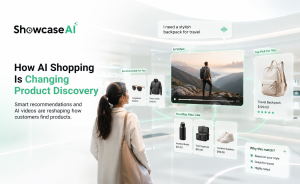
AI shopping systems are changing how customers find products.
Instead of manually browsing dozens of websites, shoppers can increasingly rely on AI-powered systems to help discover and evaluate products.
This creates a new requirement for ecommerce brands.
Products need more than a name and price.
They need clear, structured, useful, and engaging information.
Product descriptions, specifications, images, videos, reviews, and demonstrations can all contribute to the overall product experience.
The brands that provide richer product information may be better positioned for AI-assisted discovery.
Product Experiences Can Help Set Better Expectations
One major ecommerce challenge is the gap between customer expectations and the actual product.
This can happen when:
- Product photos look different from reality.
- Product size is difficult to understand.
- Features are unclear.
- The product’s usage is not demonstrated.
- Customers misunderstand how something works.
Better product experiences can address these gaps.
A demonstration can show functionality.
A video can provide additional angles.
A virtual try-on can provide context.
A talking avatar can explain important features.
The result is a more informed purchasing decision.
The Future Is Not About Replacing Product Listings
Product listings are not disappearing.
They are becoming more experiential.
Specifications will still matter.
Prices will still matter.
Reviews will still matter.
Product images will still matter.
But these elements will increasingly work together with video and interactive content.
The future product page may look less like:
Image → Description → Price → Buy
And more like:
Discover → Watch → Understand → Explore → Compare → Trust → Buy
That is a fundamentally different customer journey.
How Ecommerce Brands Can Start the Shift
Brands do not need to rebuild their entire ecommerce strategy overnight.
Start with the products that matter most.
1. Identify Your Best-Selling Products
Start with products that already generate traffic or sales.
These products have the greatest potential for improving the customer experience.
2. Find the Biggest Customer Questions
Look at reviews, support questions, search queries, and customer feedback.
Identify what customers frequently misunderstand.
Then create content that answers those questions.
3. Add Product Videos
Start with short videos that demonstrate the product clearly.
Focus on benefits instead of simply showing attractive visuals.
4. Repurpose Product Content
Do not create separate content from scratch for every channel.
Turn one product asset into multiple formats.
ShowcaseAI can support this type of content workflow by helping brands create multiple AI-powered video formats from product visuals.
5. Test Different Experiences
Compare product pages with and without video.
Monitor metrics such as:
- Engagement
- Time on page
- Add-to-cart rate
- Conversion rate
- Product returns
- Video completion rate
Use the results to improve your strategy.
Product Experience Is Becoming a Competitive Advantage
As ecommerce becomes more crowded, products alone are not always enough to differentiate a brand.
Two companies can sell similar products.
One may present a basic listing.
The other may provide:
- Product demonstrations
- AI-powered videos
- Virtual try-ons
- Detailed explanations
- Social proof
- Multiple visual experiences
The second brand can make the buying process easier and more engaging.
That experience can become a competitive advantage.
The Future of Ecommerce Is Experience-First
Ecommerce is moving beyond the question:
How do we list more products?
The better question is:
How do we help customers understand and experience every product?
AI is accelerating this transition by making visual content faster and easier to produce.
Product pages are becoming digital showrooms. Product images are becoming video assets. Static listings are becoming interactive buying experiences.
ShowcaseAI represents one example of how AI can help brands move from static product assets toward richer, video-driven product experiences.
The brands that understand this shift early can build stronger customer journeys before experience-first commerce becomes the standard.
The future of ecommerce will not simply be about having more products. It will be about creating better experiences around every product.